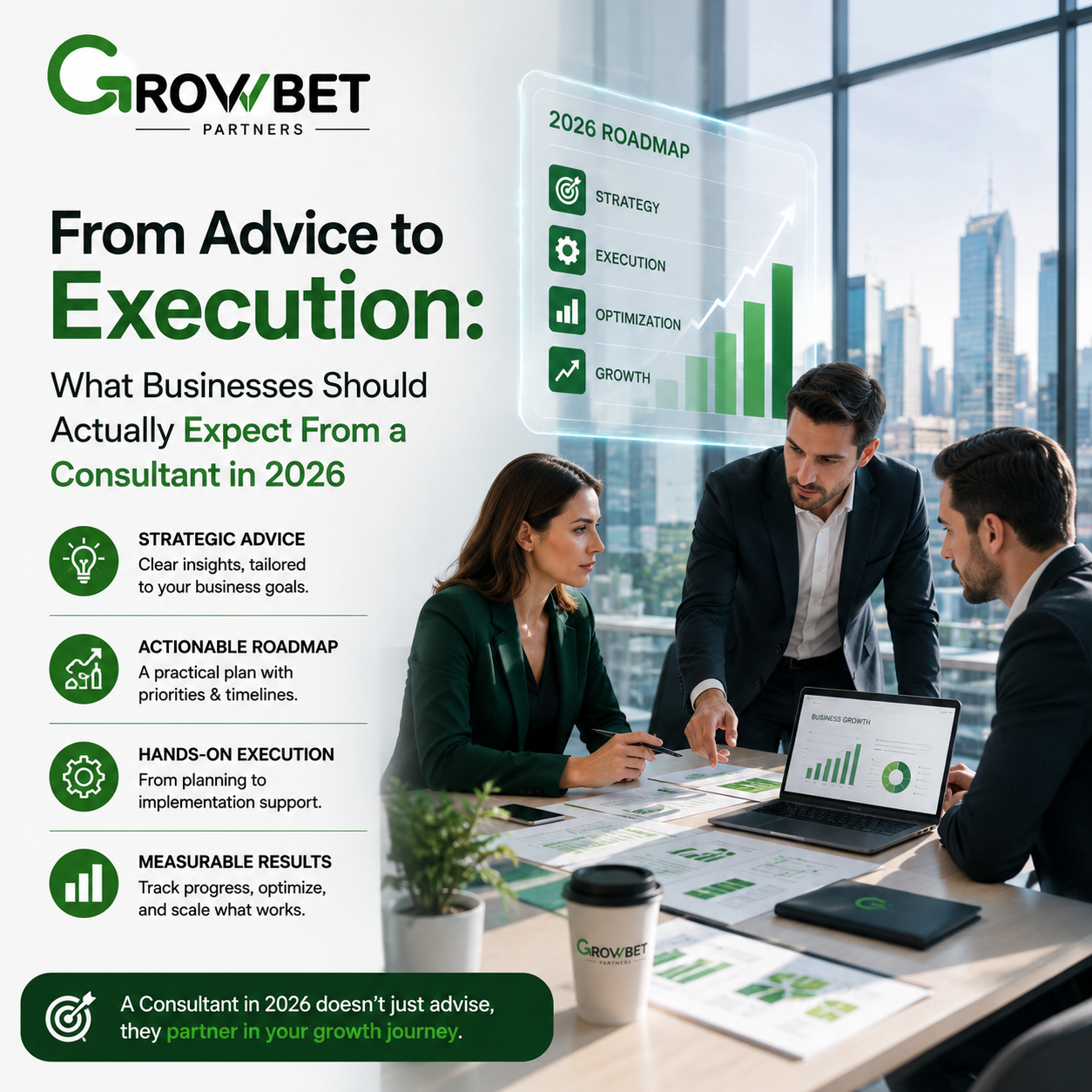
For decades, hiring a consultant meant one thing: you’d get a binder full of recommendations, a slide deck with a lot of arrows pointing at boxes, and a bill. Then the consultant would leave, and your team would be handed the job of actually making it happen.
That model is dying, and honestly, it should have died sooner.
In 2026, businesses aren’t paying for opinions. They’re paying for outcomes. If a consulting engagement ends with a PDF instead of a result, most founders and operators now consider that a failed engagement — no matter how sharp the analysis was.
So what should a business actually expect when it brings in a consultant today? Not vague promises of “strategic transformation.” Something more concrete than that.
The Old Model Is Running Out of Road
The traditional advisory model worked reasonably well when markets moved slowly and internal teams had the bandwidth to translate strategy into action. Neither of those things is true anymore.
Markets shift within quarters, not years. Competitive advantages erode faster. And most small and mid-sized businesses are already running lean, which means there’s rarely a spare team sitting around waiting to implement a 40-page strategy document.
That gap — between a good idea and a done deed — is exactly where advisory relationships used to fall apart. The consultant would present a plan, everyone would nod, and six months later almost nothing had changed. Not because the advice was bad, but because nobody owned the follow-through.
Businesses have caught on. They’re no longer buying frameworks. They’re buying implementation.
What “Execution-Ready” Consulting Actually Looks Like
If you’re evaluating a consulting partner in 2026, here’s a more useful lens than “do they have a good reputation.” Ask what happens after the recommendation is made.
- A working plan, not a wish list
A strong consultant hands you a roadmap with sequencing, ownership, and dates attached — not a list of good ideas with no path to implementation. If the deliverable can’t be turned into a project plan within a week, it isn’t finished yet.
- Involvement in the build, not just the blueprint
The best engagements today are hybrid. The consultant helps design the system, then stays close enough to help build it — whether that’s a go-to-market motion, a finance process, a market-entry structure, or a new operating rhythm for leadership.
- Change management that’s actually managed
Most failed strategies don’t fail because the strategy was wrong. They fail because the people inside the business weren’t brought along. A consultant worth paying for thinks about adoption from day one, not as an afterthought once resistance shows up.
- Measurable checkpoints, not a single big reveal
Instead of one large presentation at the end, expect shorter cycles: define, test, measure, adjust. This lets a business course-correct in weeks instead of discovering a miss a year later.
- Willingness to be judged on results
This is the clearest signal of a consultant built for 2026. If the engagement’s success criteria are fuzzy — “improved alignment,” “enhanced strategic clarity” — be cautious. If the criteria are specific — revenue growth, cost reduction, time-to-market, retention — that’s a partner who expects to be evaluated on outcomes.
Why This Shift Matters More for SMEs and Growth-Stage Companies
Larger enterprises can sometimes absorb the cost of advice that doesn’t convert into results. They have internal teams, project management offices, and enough scale to eventually make something stick.
Smaller and mid-sized businesses don’t have that luxury. Every consulting dollar has to earn its way back, usually within a defined window. That’s why execution-focused consulting has become less of a premium offering and more of a baseline expectation, particularly among founder-led companies and firms scaling across new markets.
This is also where hybrid advisory-and-execution partners have an advantage over traditional strategy houses. A firm that understands both the plan and the operational reality of running a business — hiring, compliance, market entry, technology stack, customer acquisition — can move a recommendation into practice far faster than one that only ever produces documents.
Questions to Ask Before You Sign an Engagement
Before committing budget to any consulting relationship, it’s worth asking directly:
- Who on your team actually implements this, and how involved will they be after the strategy phase?
- What does the first 30, 60, and 90 days look like in practice, not just on a slide?
- How will we know if this worked — what are the specific numbers we’re tracking?
- What happens if the plan needs to change halfway through? Is there a built-in review point?
- Can you show me an example where a previous client’s recommendation was actually implemented, and what the result was?
If a consulting firm struggles to answer any of these clearly, that’s useful information in itself.
The Bottom Line
Advice was never really the scarce resource. Most experienced operators have a decent instinct for what needs to change in their business. What’s scarce is the discipline, bandwidth, and outside accountability to actually execute on it.
The consultants who matter in 2026 aren’t the ones with the most polished frameworks. They’re the ones willing to stay in the room after the plan is approved — and be judged by what actually changes because of it.
If your last consulting engagement ended with a document instead of a result, that’s not a reason to give up on outside advisory support. It’s a reason to be more specific about what you expect from the next one.
Frequently Asked Questions
What’s the difference between advisory consulting and execution consulting?
Advisory consulting typically ends with recommendations and a strategy document. Execution consulting continues into implementation — building processes, supporting rollout, and tracking whether the plan actually produced results.
Is execution-focused consulting more expensive?
Not necessarily. Because it’s tied to measurable outcomes and often structured in phases, many businesses find it delivers better return on the same or lower budget than a one-off strategy engagement that never gets implemented.
How do I know if a consultant is truly execution-focused?
Ask for specifics: sequencing, ownership, timelines, and past examples where their recommendations were actually put into practice. Vague answers around “strategic alignment” without a concrete plan are a warning sign.