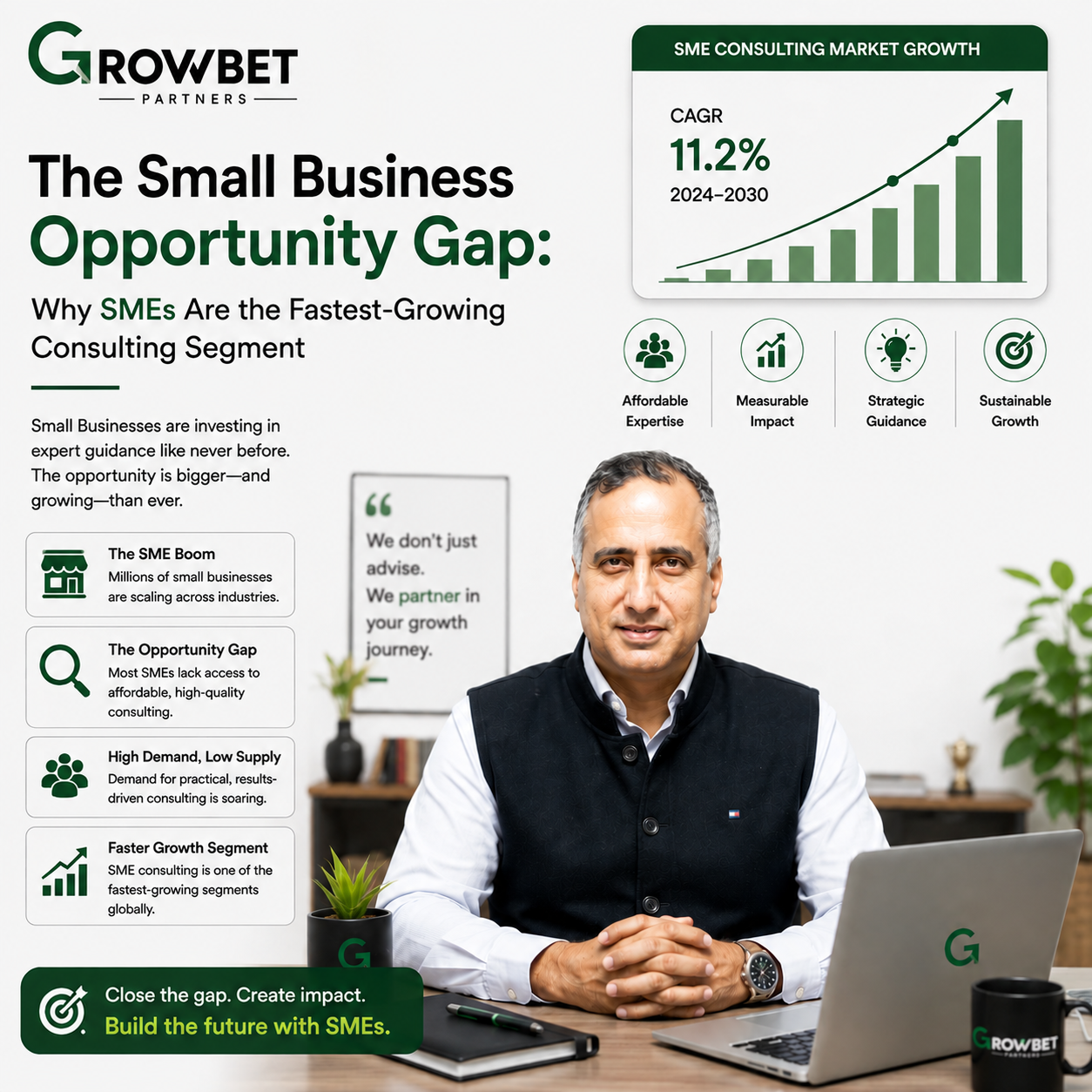
For most of the last thirty years, the consulting industry built itself around large enterprises. Fortune 500 companies had the budgets, the multi-year contracts, and the internal complexity that justified bringing in outside expertise at scale.
Small and mid-sized businesses were, for the most part, left to figure things out on their own.
That’s changed. Today, SMEs represent one of the fastest-growing segments in the consulting market, and the shift isn’t a temporary blip — it’s a structural change in who needs strategic help and why.
What’s Driving the Shift
Growth has gotten more complicated, not less
A small business in 2015 competed mostly on price, service, and local reputation. A small business today is competing with global e-commerce, AI-driven customer service, complex compliance requirements, and marketing channels that change their rules every few months. The operational bar has risen sharply, even for companies that haven’t grown much in headcount.
Founders are stretched across too many functions
Most SME leadership teams are wearing five or six hats at once. There’s rarely a dedicated person thinking full-time about pricing strategy, market entry, financial structuring, or long-term positioning — even though those decisions carry enormous weight. That’s exactly the gap outside advisory support is built to fill.
Access to consulting has become less exclusive
Historically, meaningful consulting engagements started at price points only large companies could justify. That’s no longer the case. Advisory models have adapted — shorter engagements, fixed-scope projects, and hybrid remote delivery have made high-quality strategic support accessible to a business with twenty employees, not just two thousand.
Cross-border ambition among smaller firms
More SMEs are looking beyond their home market earlier in their growth curve — whether that’s a US company exploring the Indian market, or a smaller firm anywhere trying to navigate a transatlantic expansion. That kind of move used to be reserved for companies with dedicated international teams. Now it’s increasingly attempted by leaner organizations that need outside expertise to avoid expensive missteps.
The Opportunity Gap, Defined
The “opportunity gap” isn’t about ambition — most SME leaders have plenty of that. It’s about the distance between what a small business wants to achieve and what it currently has the internal capacity, expertise, or bandwidth to pull off on its own.
That gap shows up in a few consistent places:
- Strategic clarity— knowing which two or three priorities actually matter this year, instead of chasing ten at once
- Market entry decisions— understanding regulatory, cultural, and competitive realities before committing real budget
- Financial structuring— pricing, unit economics, and funding decisions made without the benefit of a finance function
- Operational systems— processes that scaled fine at ten people but start breaking at fifty
- Governance— especially in family-run or founder-led businesses, where succession and decision rights are rarely formalized early enough
None of these gaps require a Fortune 500-style engagement to close. They require focused, practical advisory support that understands the constraints a smaller business actually operates under — limited time, limited budget, and very little tolerance for advice that can’t be implemented quickly.
Why This Segment Is Growing Faster Than Enterprise Consulting
Enterprise consulting demand tends to track fairly steadily with GDP and large-company capital spending. SME consulting demand is being pushed by something different: a widening pool of businesses that simply didn’t need — or couldn’t access — this kind of support a decade ago.
A few forces are compounding this:
- Digital-first businesses reach meaningful scale faster, and hit strategic inflection points earlier than traditional companies did at a similar size.
- Government and institutional support for SMEs— grants, incubators, trade programs — has expanded in multiple regions, often with a requirement or incentive to bring in outside expertise.
- Founders are more comfortable outsourcing strategic thinking, particularly younger business owners who see it as a normal input rather than an admission that something is wrong.
- The cost of getting it wrong has increased.A bad market-entry decision or mispriced product line can burn through a small company’s runway far faster than it would for a larger one, which raises the value of getting outside eyes on the decision before it’s made.
What This Means If You Run an SME
If you’re leading a small or mid-sized business, the opportunity gap isn’t a reason to feel behind — it’s simply the normal condition of scaling a company with limited internal resources. The businesses that close it fastest tend to do a few things well:
- They bring in outside expertise for specific, well-defined problems rather than vague “help us grow” engagements
- They look for advisors who’ve worked with businesses at a similar stage, not just large enterprises
- They prioritize speed to implementation over exhaustive analysis
- They treat consulting as an ongoing input into decision-making, not a one-time event
What This Means If You’re a Consulting Provider
For advisory firms, the SME segment rewards a different operating model than enterprise work. Engagements need to be faster, more focused, and priced in a way that reflects an SME’s budget reality — without cutting corners on quality. Firms that build genuine expertise in this segment, rather than treating it as a smaller version of enterprise consulting, tend to win disproportionate trust and repeat business, because founders talk to other founders.
The Bottom Line
The consulting industry’s center of gravity is shifting. SMEs aren’t a secondary market anymore — they’re one of the segments defining where advisory demand is actually growing. For business owners, that means more accessible, more relevant support than existed even five years ago. For consulting firms, it means the businesses willing to build the right model for this segment are positioned to grow alongside it.
Frequently Asked Questions
Why is SME demand for consulting growing faster than enterprise demand?
Enterprise consulting demand tends to grow in line with large-company capital spending. SME demand is being driven by a structurally larger pool of businesses that now need — and can access — strategic support that used to be out of reach.
What kind of consulting do small businesses need most?
Most commonly: strategic prioritization, market entry decisions, pricing and financial structuring, operational systems that scale, and governance — particularly in founder-led businesses.
Is consulting worth it for a small business with a limited budget?
It can be, provided the engagement is scoped tightly around a specific decision or problem, and the consultant has direct experience working with businesses of a similar size — not just larger enterprises.