


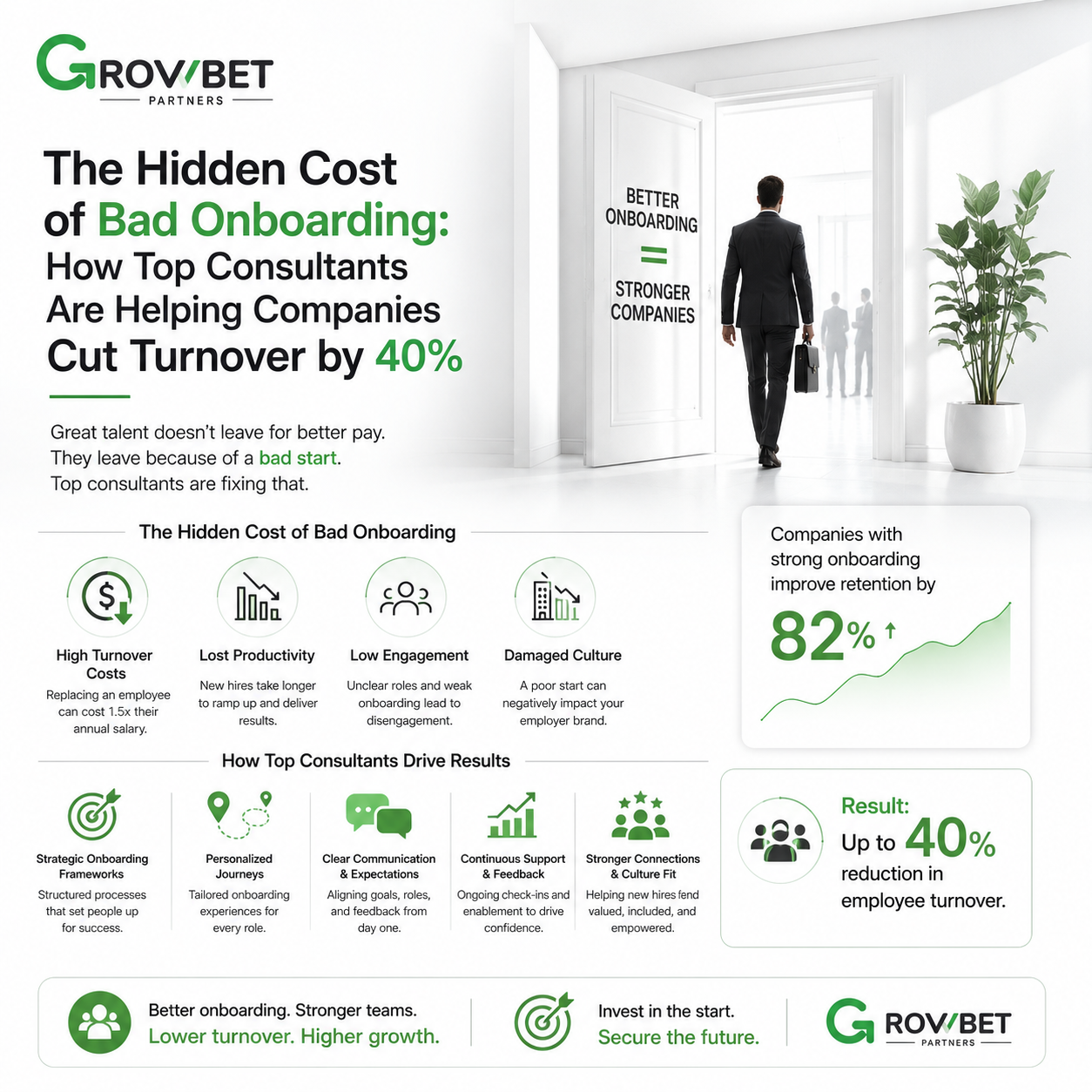
Most companies measure onboarding success by whether a new hire shows up on day one with a laptop, a login, and a seat assignment. By that standard, onboarding looks fine almost everywhere. But onboarding’s real job is to get a new employee to full productivity and genuine commitment to the company as quickly as possible, and by that standard, most onboarding programs are quietly failing. The cost of that failure doesn’t show up as a line item on the budget. It shows up months later as turnover, and turnover is one of the most expensive, least visible costs a company carries.
The Real Cost of Bad Onboarding (It’s More Than You Think)
When a new hire leaves within the first six months, the visible cost is the obvious one: another round of recruiting fees, job postings, and interview hours. The hidden costs are larger and easier to ignore.
- Lostproductivity during the weeks the role sits empty and the months it takes a replacement to reach full output.
- Managerand team time spent training someone who then leaves, requiring the entire process to
- Knowledgeand relationship loss, especially in client-facing or technical roles where context takes months to rebuild.
- Teammorale impact, since repeated early departures erode confidence in leadership and increase the flight risk of remaining staff.
Estimates of total replacement cost vary by role and industry, but it is common for the fully loaded cost of replacing an employee, including lost productivity, to run into multiples of that employee’s monthly salary. For a company replacing dozens of roles a year due to early attrition, that adds up to a substantial, ongoing drain that rarely appears as a single visible expense.
Why Turnover Spikes in the First 90 Days
New hires who leave early are rarely leaving because the job itself was wrong for them. More often, they’re leaving because the first weeks failed to deliver what they were promised, or because no one helped them figure out how to actually succeed in the role. The most common failure points consultants identify are remarkably consistent across industries:
- A gap between what was described in the interview and the reality of the day-to-day
- No clear 30/60/90-day plan, leaving the new hire unsure what ‘good’ looks
- Administrativefriction in the first week (missing access, unclear reporting lines) that signals disorganization before any real work begins.
- Little to no structured connection to a manager or peer beyond a single welcome
- Feedback that arrives too late, or not at all, for the new hire to course-correct early
What Top Consultants Do Differently
Consultants who specialize in fixing onboarding rarely start by adding more content to the process. Most broken onboarding programs already have too much content and too little structure. Instead, the common approach centers on a small number of shifts:
They separate logistics from integration
Paperwork, system access, and compliance training are necessary but are not what determines whether someone succeeds. Top programs handle logistics efficiently and quickly, then devote the majority of onboarding time to integration: understanding the team, the unwritten norms, and how success is actually measured in that specific role.
They extend the timeline
Effective onboarding programs typically run 90 days or longer, with defined checkpoints, rather than ending after a single orientation week. The early weeks build foundational knowledge; the following months build confidence and full productivity.
They assign real ownership
A dedicated onboarding buddy or mentor, separate from the direct manager, gives new hires a low-pressure way to ask questions they might not raise with their boss. This single change is consistently associated with stronger early retention.
They build in two-way feedback loops
Rather than waiting for an annual review, structured check-ins at 30, 60, and 90 days let both the new hire and the company surface problems while they’re still easy to fix.
The 40% Turnover Reduction Framework
While exact figures vary by organization, consultants reporting turnover reductions in the range of 40 percent generally point to the same underlying framework, applied consistently rather than as a
one-time initiative:
- Pre-boarding:Send access, equipment, and a clear first-week agenda before day one so no time is lost to logistics.
- Role clarity: Provide a written 30/60/90-day plan with specific, observable goals for each
- Structuredrelationships: Assign both a manager check-in cadence and a peer buddy from day
- Scheduledfeedback: Build formal check-ins at 30, 60, and 90 days into the calendar before the hire even starts.
- Measurement:Track 90-day and one-year retention by hiring manager and department to identify where onboarding is breaking down.
How to Audit Your Onboarding Process
A useful audit doesn’t require outside consultants to get started. Leadership can run a basic version internally by answering a few direct questions about the current process.
- What percentage of new hires who left in the past year departed within their first 90 days?
- Doesevery new hire receive a written plan for their first 30, 60, and 90 days, or does this vary by manager?
- Is there a person, other than the direct manager, whose job is to check in with new hires regularly?
- Whenwas the new-hire experience last reviewed from the employee’s perspective, rather than HR’s?
- Isonboarding success measured at all, or treated as complete once orientation paperwork is signed?
If most of these questions are hard to answer, that itself is useful information: it usually means onboarding is happening informally and inconsistently, which is the single biggest predictor of preventable early turnover.
Frequently Asked Questions
How is the cost of bad onboarding actually calculated?
Most frameworks add direct recruiting costs to the lost productivity from an empty seat, training time from managers and peers, and the ramp-up period needed for a replacement to reach full output. The combined figure is almost always larger than the recruiting cost alone.
Is a 40% reduction in turnover realistic for every company?
Results vary by industry, role type, and how broken the existing process was to begin with. Companies starting from a very informal or inconsistent onboarding process tend to see the largest gains from adding structure.
Should small companies without an HR department still build a formal onboarding program?
Yes. A formal program doesn’t require a large HR team, it requires a written 30/60/90-day plan, a designated point of contact beyond the manager, and a few scheduled check-ins. These can be run by a single manager or founder.
How long should an onboarding program last?
Most effective programs run at least 90 days, with some extending check-ins through the first year for more complex or senior roles.