


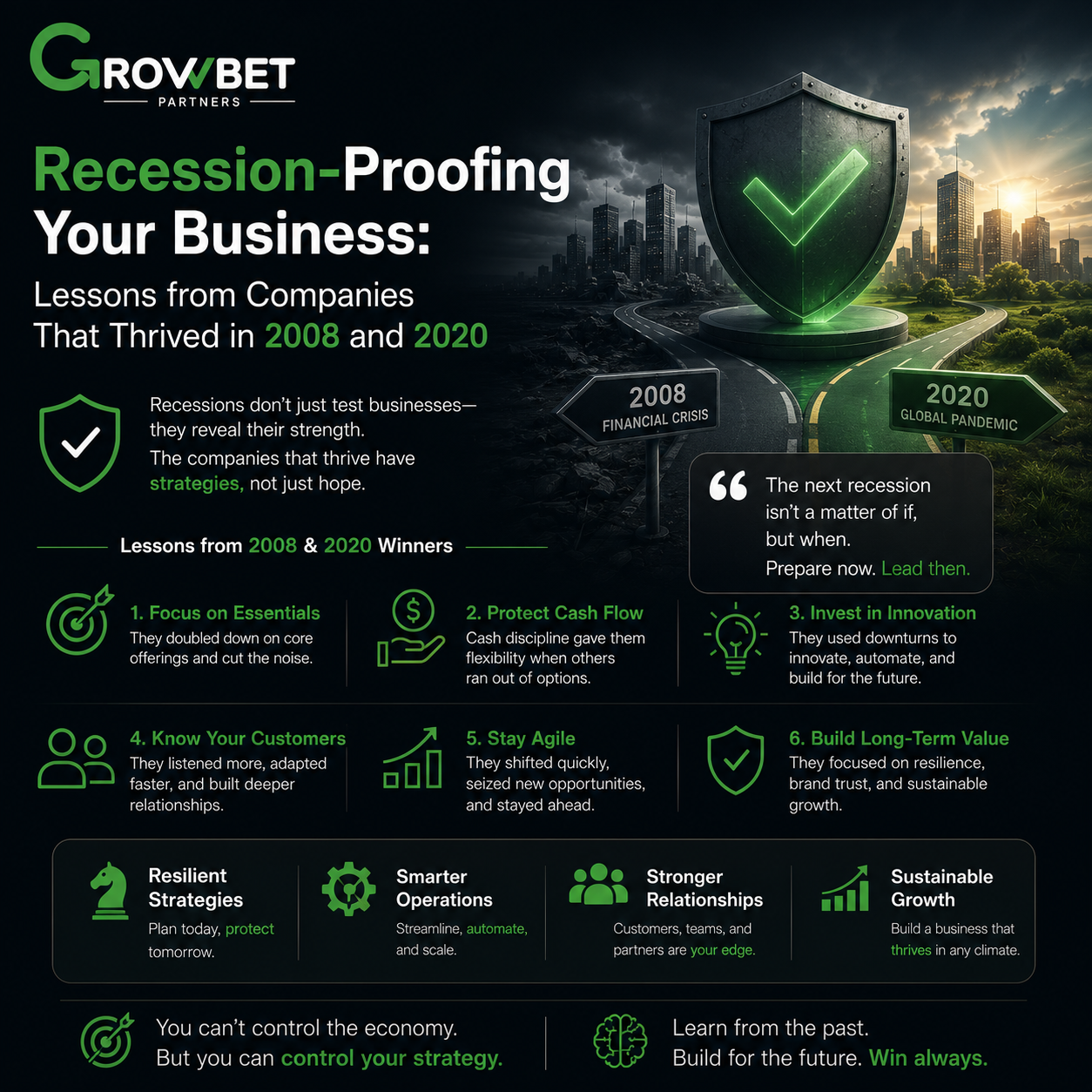
Every downturn produces two groups of companies: those that shrink to survive, and a smaller group that uses the same conditions to gain ground. The 2008 financial crisis and the 2020 pandemic were caused by completely different forces, one financial, one a public health event, yet the businesses that came out stronger from each one made remarkably similar decisions. Recession-proofing isn’t about predicting the next downturn. It’s about building a small number of structural habits now, while conditions are calm, so the business is already positioned correctly when conditions change.
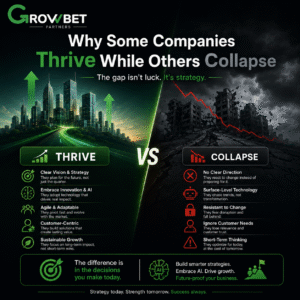
Why Some Companies Thrive While Others Collapse
The companies that struggled most in both 2008 and 2020 generally shared three traits going into the downturn: thin cash reserves, a single dominant revenue stream, and slow internal decision-making. The companies that thrived shared the opposite traits, and crucially, they had usually built those traits years before the crisis arrived rather than scrambling once it hit. That timing detail matters: recession-proofing is preparation work done during good years, not a crisis-response plan written during a bad one.
Lesson 1 from 2008: Cash Is King
The 2008 crisis was, at its core, a credit crisis. Businesses that relied heavily on borrowed capital or revolving credit found that financing dried up overnight, regardless of how healthy their underlying operations were. Companies holding larger cash reserves, or with low debt loads, had the freedom to keep operating, retain key staff, and in some cases acquire distressed competitors at low prices while everyone else was retrenching.
The practical takeaway for any business today is to treat a cash reserve as a strategic asset, not idle money. A reserve large enough to cover several months of fixed costs gives a leadership team the ability to make calm decisions instead of reactive ones when revenue dips.
Lesson 2 from 2020: Digital Agility Wins
The 2020 downturn punished companies that depended on a single physical channel: a storefront, an office-based sales process, an in-person service model. Businesses that already had even basic digital infrastructure, an e-commerce option, remote-capable operations, digital payment and ordering systems, were able to shift volume to those channels within weeks. Businesses without that infrastructure often had to build it under emergency conditions, at higher cost and with worse execution.
The lesson generalizes beyond any one crisis: redundancy in how a company reaches and serves customers is a resilience feature, not just a growth feature. A business that can operate through more than one channel is harder to knock out entirely.
Lesson 3: Diversify Revenue Streams
Single-customer or single-industry concentration is one of the most common reasons mid-size companies fail during downturns. A business that depends on one large client, one geographic market, or one industry vertical is exposed to that single point of weakness regardless of how well it’s run otherwise.
- Diversify across customer segments so no single client represents an outsized share of
- Diversifyacross industries served, where feasible, so a downturn concentrated in one sector doesn’t take the whole business with it.
- Addat least one recurring-revenue line, such as a subscription, service contract, or maintenance offering, to reduce dependence on one-off sales.
Lesson 4: Customer Relationships Over Discounts
During both downturns, companies that competed primarily on price found themselves in a race to the bottom that eroded margins right when they needed them most. The companies that retained customers most effectively instead leaned on relationship strength: proactive communication, flexible terms for trusted long-term clients, and visible reliability when competitors were cutting service levels to save costs.
Discounting can move volume in the short term, but it trains customers to expect lower prices permanently and rarely builds the loyalty needed to retain them once a competitor matches the discount.
Lesson 5: Lean Operations Without Losing Talent
Layoffs are often the first lever pulled in a downturn, and sometimes they are unavoidable. But companies that thrived in both 2008 and 2020 tended to exhaust other cost levers first: renegotiating vendor contracts, freezing non-essential spending, cross-training staff to cover multiple roles, and slowing hiring rather than cutting existing teams. Losing experienced employees is expensive to
reverse once conditions improve, and competitors who protected their talent through the downturn were able to scale back up faster during the recovery.
Building Your Recession-Proof Playbook
None of these lessons require predicting when the next downturn will happen. They require putting a small number of structural protections in place now.
- Seta target cash reserve (commonly three to six months of fixed operating costs) and a timeline to reach it.
- Mapwhat percentage of revenue comes from your single largest client, market, and channel, and set a concentration limit for each.
- Build or strengthen at least one digital channel that doesn’t depend on physical
- Add one recurring-revenue offering if you don’t already have
- Writea short cost-reduction sequence in advance, ranked by what to cut first, second, and last, so the decision is made in calm conditions rather than under pressure.
The goal isn’t to avoid every downturn’s impact entirely; that’s rarely possible. The goal is to be one of the companies that comes out the other side with market share gained rather than lost.
Frequently Asked Questions
How much cash reserve should a small or mid-size business actually keep?
A commonly cited benchmark is three to six months of fixed operating costs, though businesses with more volatile revenue or seasonal cycles often aim higher.
Is diversifying revenue streams realistic for a small business with limited resources?
It doesn’t require entering entirely new industries. Adding one new customer segment, one new geography, or one recurring-revenue product alongside the existing core business is often enough to meaningfully reduce concentration risk.
Did every industry experience 2008 and 2020 the same way?
No. Impact varied significantly by sector, for example, travel and hospitality were hit hardest in 2020 while financial services and real estate were hit hardest in 2008. The underlying resilience principles, however, applied across most industries.
What’s the single most important first step for a business starting this process today?
Most resilience plans start with an honest audit: current cash position, customer concentration, and channel dependence. That audit usually reveals which lesson from this list is most urgent for your specific business.