


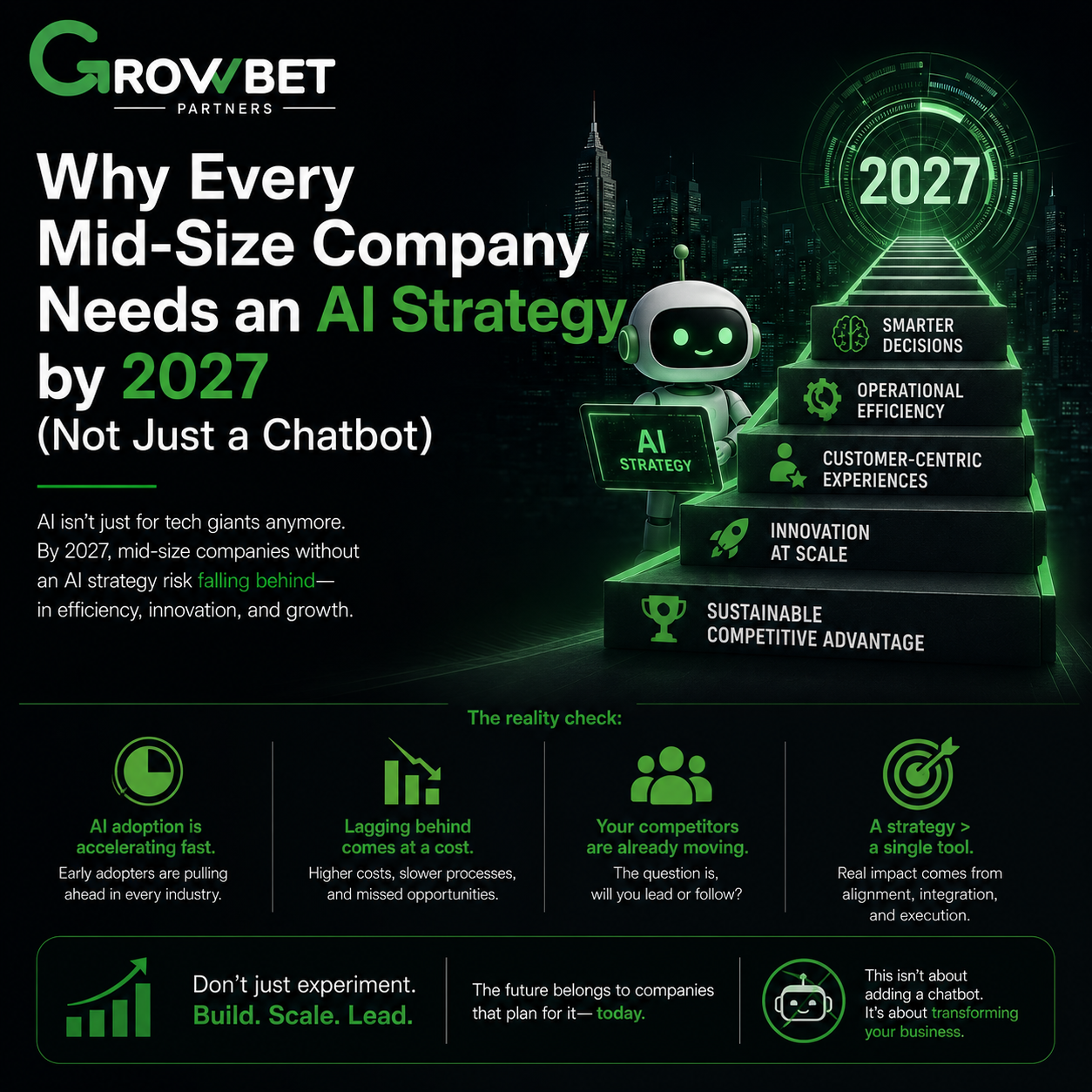
Most mid-size companies already have some form of AI in their business. A customer-service chatbot here, an AI writing assistant there, maybe a sales tool with a built-in recommendation engine. The problem is that having AI tools is not the same as having an AI strategy, and that gap is about to become very expensive. By 2027, the companies that have only dabbled in AI on a tool-by-tool basis will be competing against rivals who have rebuilt entire workflows around it. This article explains why a real AI strategy matters now, what separates strategy from tool-shopping, and how a mid-size company can build one without a Fortune 500 budget.
The Chatbot Trap: Why Surface-Level AI Adoption Falls Short
Installing a chatbot is the easiest, most visible way to say a company is ‘using AI.’ It is also the lowest-leverage use of the technology. A chatbot answers questions; it doesn’t redesign how work gets done. Many leadership teams stop there because a chatbot is quick to deploy, easy to demo in a board meeting, and doesn’t require touching core systems.
The risk is that this single deployment becomes a substitute for actual strategic thinking. Leadership checks the ‘we use AI’ box, momentum stalls, and the organization never gets to the higher-value applications: forecasting, pricing optimization, supply chain planning, internal knowledge retrieval, and decision support across departments. Competitors who go further capture compounding advantages in cost structure and speed that a chatbot alone cannot match.
What an AI Strategy Actually Is (And How It Differs From a Chatbot)
An AI strategy is a structured plan for where, why, and how artificial intelligence will be used across the business over the next several years, tied directly to specific financial or operational outcomes. It is not a list of software purchases. A useful way to think about the difference:
- Tooladoption asks: ‘What AI product should we buy?’ Strategy asks: ‘Which business outcomes are we trying to move, and what mix of data, process change, and tooling gets us there?’
- Tooladoption is owned by whichever department requests the Strategy is owned at the leadership level, with clear accountability for ROI.
- Tooladoption is judged by usage Strategy is judged by measurable impact on revenue, cost, retention, or speed.
A company with a real AI strategy can answer, in one sentence, how its use of AI connects to its three-year business plan. A company without one usually cannot.
The 2027 Deadline: Why Timing Matters for Mid-Size Companies
Large enterprises have spent the last several years building internal AI platforms, data pipelines, and governance frameworks. Small businesses often move fast and informally because they have fewer layers of approval. Mid-size companies sit in the uncomfortable middle: large enough to need formal data governance and risk management, but without the dedicated AI teams that bigger competitors already have in place.
Three forces are converging around 2026 and 2027 that make this gap costly. First, AI-native competitors and well-funded startups are entering mid-market categories with cost structures that established players cannot match without similar automation. Second, customers and B2B buyers increasingly expect faster turnaround, more personalized service, and self-serve options that are difficult to deliver without AI-supported operations. Third, the talent and tooling needed to implement AI well are becoming more accessible and lower-cost every quarter, which means the excuse of ‘we don’t have the budget or expertise yet’ has a shrinking shelf life.
Waiting does not preserve optionality. It simply means a company will eventually have to implement the same changes later, under more competitive pressure, with less runway to get it right.
Five Pillars of a Real AI Strategy
1. Data Infrastructure
AI is only as useful as the data behind it. Many mid-size companies have data scattered across disconnected systems: a CRM, a separate finance tool, spreadsheets nobody else can open, and departmental databases that don’t talk to each other. Before any meaningful AI initiative can scale, a company needs a realistic map of where its data lives, how clean it is, and what it would take to make it usable.
2. Workflow Integration
AI delivers value when it is embedded inside an existing process, not bolted on beside it. A support team that has to copy-paste between a chatbot and their ticketing system gains far less than one where the AI tool reads and writes directly into that ticketing system. Strategy means deciding which three to five workflows will be redesigned first, based on where the time or cost savings are largest.
3. Talent and Training
Most mid-size companies do not need to hire a team of machine learning engineers. They do need a small number of people, often existing employees, who understand both the business processes and the available tools well enough to lead implementation, and a training plan so the rest of the workforce can use the new systems confidently rather than working around them.
4. Governance and Risk
An AI strategy without guardrails creates new liabilities: inaccurate outputs reaching customers, sensitive data flowing into the wrong tools, or decisions made without a human checkpoint where one is legally or ethically required. A short, practical policy covering acceptable use, data handling, and review steps for high-stakes decisions protects the company as it scales adoption.
5. A Measurable ROI Framework
Every initiative should have a baseline metric, a target, and an owner before it launches: hours saved per week, reduction in response time, percentage lift in conversion, decrease in error rate. Without this, it becomes impossible to tell which AI investments are working and which should be cut.
Common Mistakes Mid-Size Companies Make
- Buying tools before defining the problem they are meant to
- Treating AI as an IT department project instead of a cross-functional, leadership-led
- Rolling out a tool company-wide before testing it on one team or one
- Skipping employee training and assuming adoption will happen on its
- Never revisiting or measuring results after the initial
How to Build Your AI Strategy: A Practical Roadmap
A workable AI strategy does not require a year-long consulting engagement. A focused mid-size company can build a credible first version in 60 to 90 days by following a simple sequence.
- Audit:List every current AI tool in use, who uses it, and what it actually Identify the biggest time-sinks and bottlenecks across departments, AI-related or not.
- Prioritize:Pick two or three high-friction workflows where better data or automation would save the most time or money, rather than trying to transform everything at once.
- Pilot: Run a 30 to 60 day pilot on one workflow with a clear metric and a named
- Govern:Draft a one-page acceptable-use and data-handling policy before scaling beyond the
- Scaleand review: Expand what works, kill what doesn’t, and revisit the roadmap on a quarterly basis as tools and internal capability mature.
The companies that will still be competitive in 2027 are not necessarily the ones using the most advanced AI today. They are the ones treating it as an ongoing strategic capability rather than a one-time purchase, and building the internal habits to keep improving it.
Frequently Asked Questions
Do small and mid-size companies really need a formal AI strategy, or is that overkill?
A strategy doesn’t need to be a lengthy document. Even a one-page plan that names the priority workflows, the owner, and the success metric counts as a real strategy and outperforms ad-hoc tool adoption.
What’s a realistic budget for a mid-size company to start an AI strategy?
Many companies start with existing software subscriptions and staff time rather than new headcount. The first 60 to 90 days are typically about process and pilots, not large capital spending.
Should the AI strategy be owned by IT or by business leadership?
Business leadership should own the strategy and outcomes, with IT as a key implementation partner. AI initiatives that live only inside IT tend to optimize for technical novelty rather than business results.
How is an AI strategy different from a digital transformation plan?
Digital transformation is broader and often covers systems modernization generally. An AI strategy is narrower: it focuses specifically on where machine intelligence can replace, augment, or accelerate decisions and tasks within that broader plan.