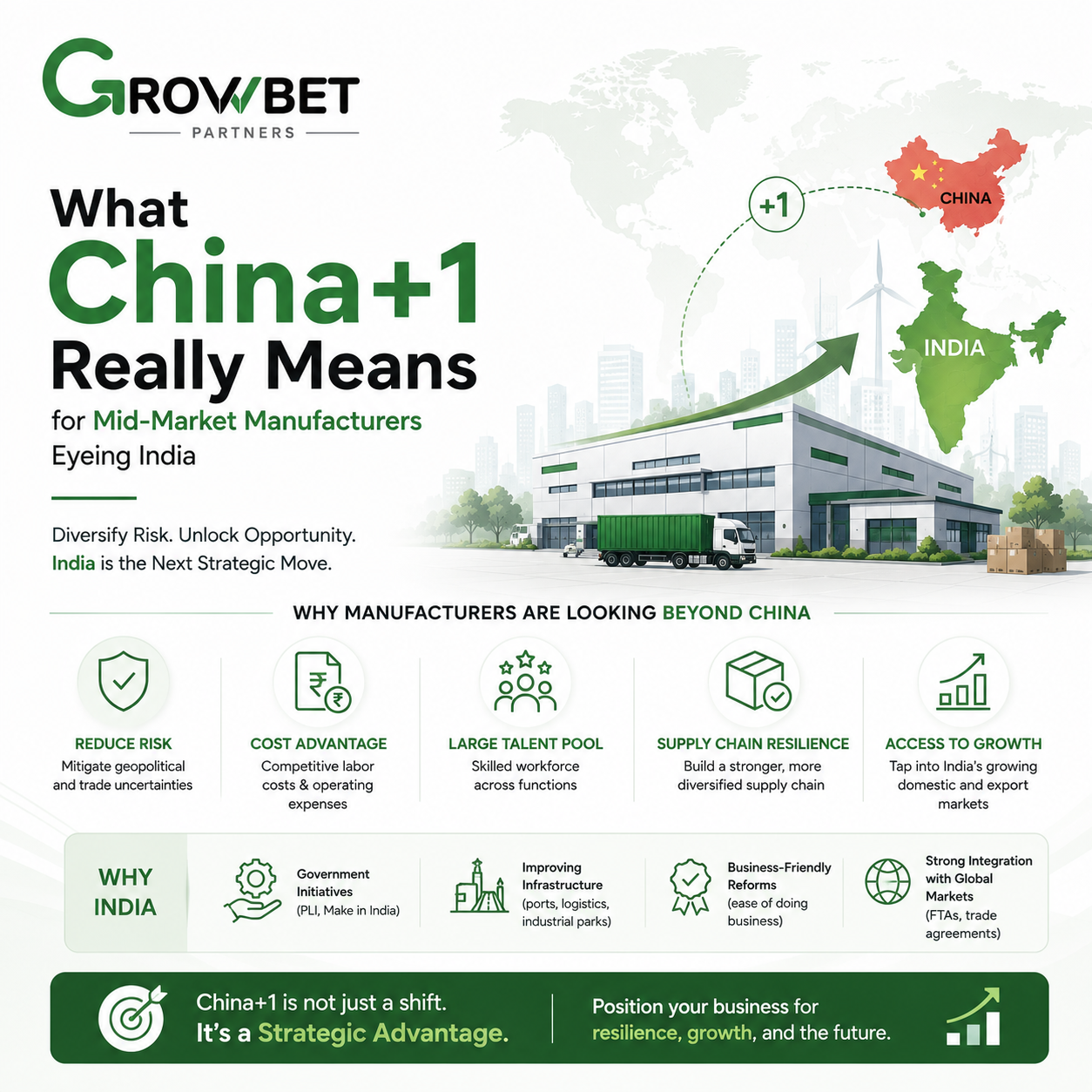
China+1 has become one of the most repeated phrases in global manufacturing strategy, but for
mid-market manufacturers the term is often used loosely. India’s Production-Linked Incentive scheme now spans 14 strategic sectors with a combined outlay of roughly ■1.97 lakh crore, or about USD 26 billion, making it the largest manufacturing policy support architecture in the country’s history. As of December 2025, the government had approved 836 PLI applications, attracting committed investments of over ■2.16 lakh crore and generating cumulative sales above ■20.41 lakh crore.
China+1 Is a Strategy, Not a Single Decision
Moving a portion of manufacturing capacity to India is not a one-time relocation project; it is a
multi-year strategy involving supplier development, workforce training, and quality systems that match existing standards. Mid-market manufacturers who treat it as a single facility decision often underestimate the ecosystem-building required around that facility, including component suppliers, logistics partners, and testing infrastructure.
Where India Genuinely Competes Today
Smartphone and mobile phone exports became India’s single largest export category in FY2024-25, reaching roughly USD 30 billion across all brands, with Apple alone reportedly exporting close to ■2 trillion worth of iPhones from India in calendar 2025. Electronics, pharmaceuticals, textiles, automotive components, and specialty chemicals are the sectors where PLI-linked capacity has scaled fastest, and mid-market companies evaluating India should check sector-specific PLI eligibility early, since incentive value can materially change project economics.
Where the Gaps Still Exist
India’s component supplier base for certain categories remains less mature than China’s. The government’s newer Electronics Components Manufacturing Scheme (ECMS) is designed specifically to close this gap, targeting an increase in domestic component value addition from around 19% to roughly 30% over the next four years. Until that shift happens at scale, manufacturers should plan for a hybrid sourcing model, importing key components while assembling or finishing products domestically, rather than assuming full local sourcing is achievable immediately.
Logistics and Infrastructure Considerations
Port connectivity, freight corridor reliability, and power infrastructure vary significantly by state and industrial cluster. Manufacturers should evaluate specific clusters built around dedicated freight
corridors or established special economic zones rather than treating India as a single homogeneous location, since the difference in logistics reliability between a mature cluster and an emerging one can materially affect delivery timelines to export markets.
Ownership Rules Are Also Getting Easier
Manufacturing remains open to 100% FDI under the automatic route in most sub-sectors, and a March 2026 amendment to Press Note 3 rules eased restrictions further by allowing limited
non-controlling beneficial ownership from land-border-country investors. Combined with active trade frameworks such as the India-UAE CEPA and India-Australia ECTA, this gives mid-market manufacturers more structural flexibility than they had even two years ago.
A Realistic Timeline for Mid-Market Manufacturers
Most mid-market manufacturers underestimate how long a genuine China+1 transition takes. From site selection to stable, quality-consistent production typically spans eighteen months to three years, depending on product complexity and how much of the supplier ecosystem needs to be built alongside the primary facility.
Conclusion
China+1 is a legitimate and increasingly well-supported strategy for mid-market manufacturers managing supply chain risk, backed by a PLI architecture that has already disbursed close to
- 28,748 crore in incentives. What separates successful diversification from a stalled project is
realistic planning around supplier ecosystems, sector-specific incentives, and regional infrastructure, rather than treating India as a simple drop-in replacement for existing capacity.