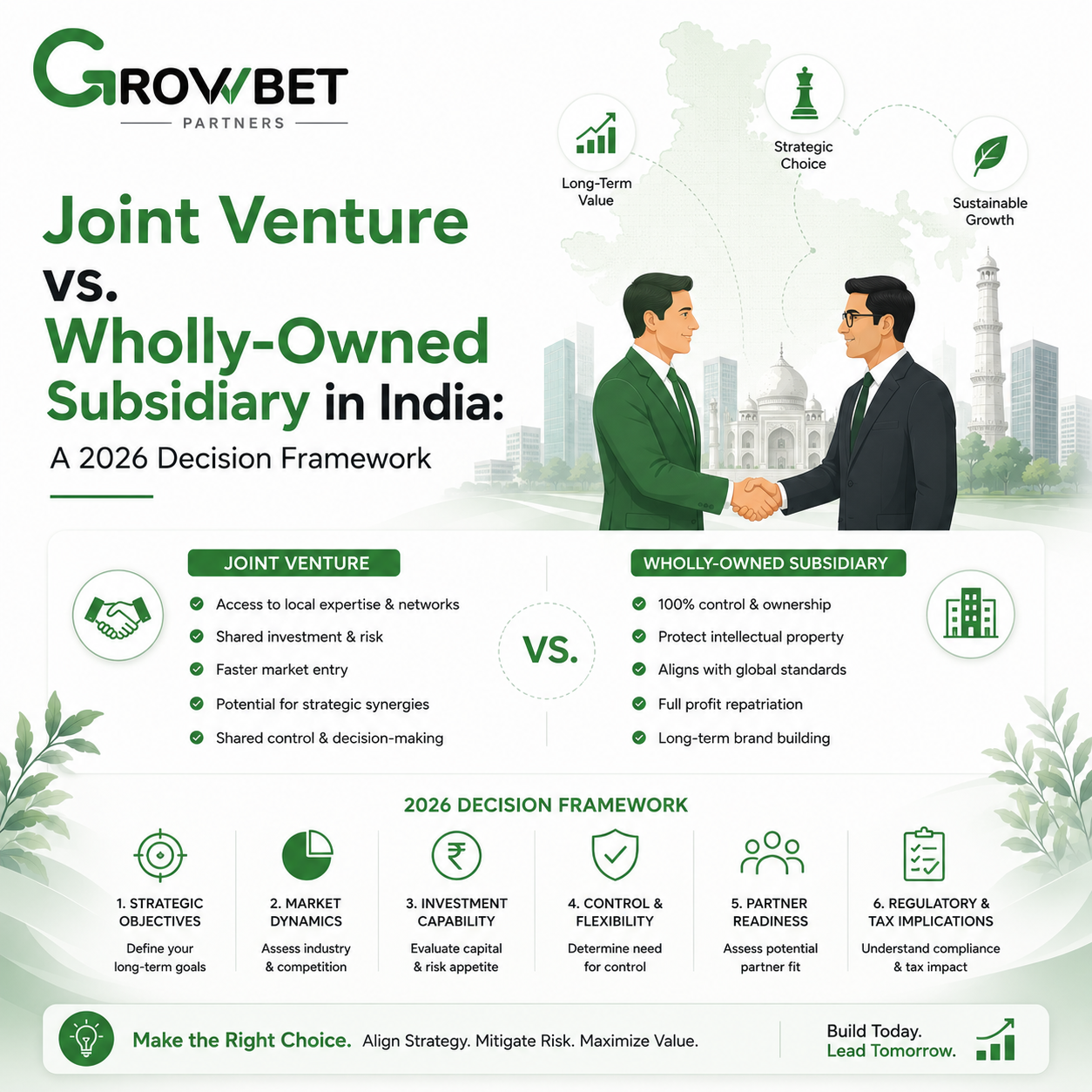
Foreign companies entering India in 2026 face a decision that shapes everything from speed to market to long-term control: joint venture with a local partner, or wholly-owned subsidiary. India’s FDI framework has been liberalized significantly over the past two years — gross FDI inflows reached roughly USD 81 billion in FY2024-25, a jump of around 14% over the previous year — but
sector-specific caps still shape which structure is realistic for a given business.
What a Joint Venture Actually Offers
A joint venture pairs a foreign company with an Indian partner who typically brings market access, regulatory relationships, distribution networks, and local operational knowledge. This can meaningfully shorten the time to revenue, particularly in sectors like retail, infrastructure, and consumer goods where local relationships and last-mile distribution are hard to replicate quickly. The trade-off is shared control and shared profits, along with the operational complexity of aligning two corporate cultures.
What a Wholly-Owned Subsidiary Offers
A wholly-owned subsidiary gives the foreign parent full control over strategy, hiring, technology, and brand standards, along with complete ownership of profits. Manufacturing, renewable energy, and infrastructure remain open to 100% FDI under the automatic route, making a wholly-owned structure straightforward in these sectors. This suits companies with strong brand equity or proprietary technology they want to protect fully.
Sector-Specific FDI Rules Still Matter in 2026
The 2025-26 reform cycle has meaningfully expanded automatic-route access: the insurance sector cap was raised from 74% to 100% for automatic-route investment, and the defense sector automatic-route limit was raised from 49% to 74%, with 100% possible via government approval.
Telecom now permits 100% FDI under the automatic route. Multi-brand retail, print media above 26%, and private banking above 74% still require government approval, which typically adds four to eight weeks to the approval timeline. Any entry decision has to start with a current review of these
sector-specific limits, since they have shifted meaningfully in the last two budget cycles.
The Real Cost of Getting the Partner Wrong
Joint ventures fail more often over misaligned expectations than over legal disputes. Common friction points include disagreements over reinvestment versus dividend payouts, differing risk appetites for
aggressive growth, and unclear exit mechanisms if the partnership does not work. A well-drafted shareholders’ agreement with clear deadlock-resolution and buyout clauses is the single document that determines whether a joint venture survives its first serious disagreement.
When a Wholly-Owned Subsidiary Is the Safer Bet
Companies with deep pockets, a strong global brand, and a multi-year time horizon often find that a wholly-owned subsidiary avoids the governance complexity of shared ownership entirely. This is particularly true where a company’s competitive advantage rests on proprietary processes or intellectual property, since sharing control with a local partner introduces real risk of knowledge transfer to a future competitor. A March 2026 amendment to Press Note 3 rules also now permits non-controlling beneficial ownership of up to 10% for certain land-border-country investors via the automatic route, a change worth reviewing for companies with complex ownership structures.
A Practical Framework for the 2026 Decision
Companies should map their entry decision against four questions: does the sector legally permit full foreign ownership under the current automatic-route rules, does the company already have
India-specific market knowledge and relationships, how sensitive is the core intellectual property to a shared-ownership structure, and how much time pressure exists to reach revenue and market-share targets.
Conclusion
Neither structure is inherently superior. With most sectors now open to 100% automatic-route FDI, the right entry model in 2026 depends less on regulatory permission and more on a clear-eyed assessment of local partnership value versus full control. Getting independent, India-specific advice before finalizing the structure remains the most effective way to avoid costly missteps in the first two years of operation.