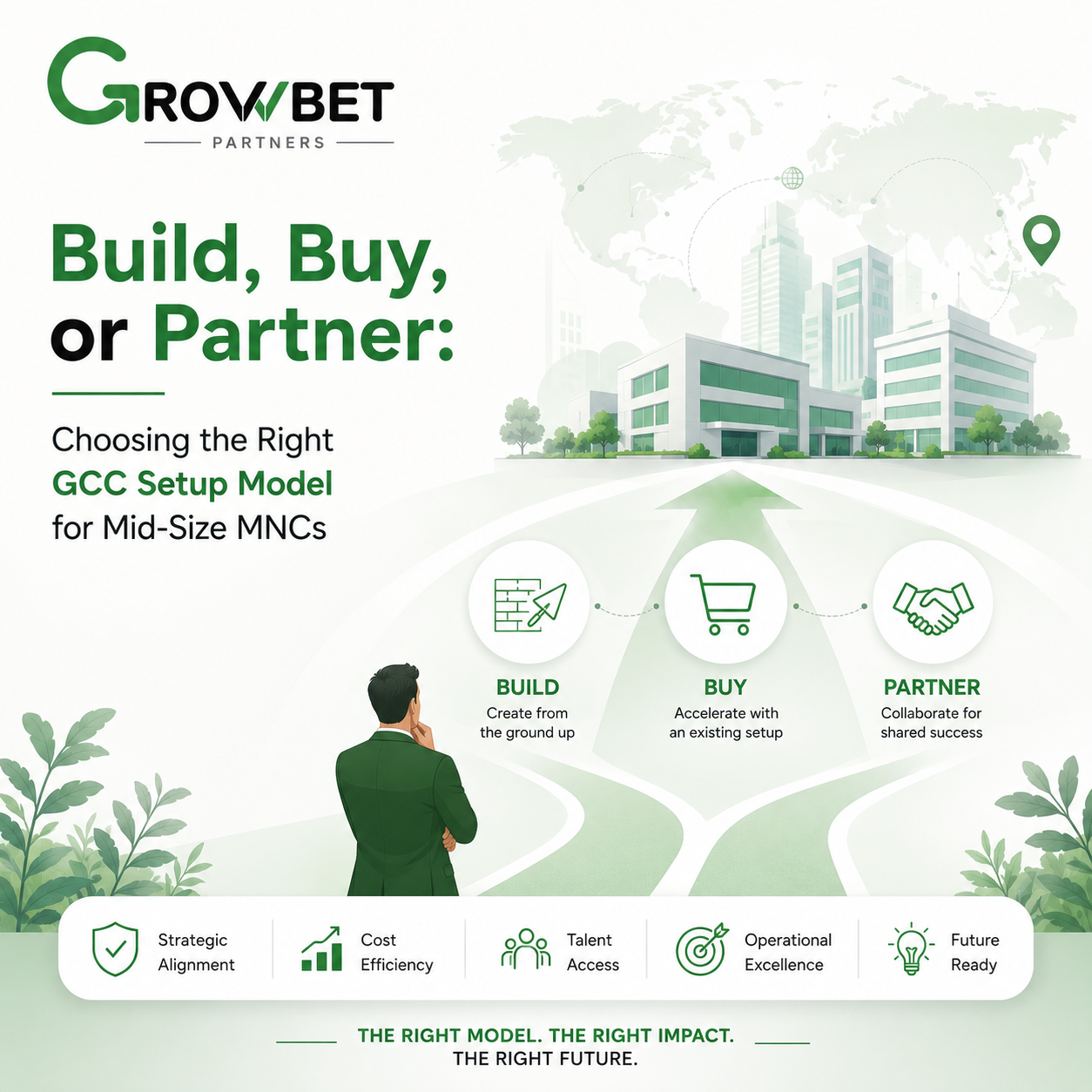
India’s Global Capability Center ecosystem has scaled past 1,900 centers, employing more than 2.1 million professionals and contributing over 1.5% of the country’s GDP, according to industry estimates. For mid-size multinational companies evaluating entry into this ecosystem, the foundational question is not whether to set up a GCC, but which setup model — build, buy, or partner
— fits their timeline, risk appetite, and capital position.
The Build Model: Full Control, Full Responsibility
Building a GCC from scratch gives a company complete control over culture, hiring standards, technology stack, and long-term alignment with the parent organization. It suits companies planning a large, multi-year India presence where the capability center will become central to global operations. The trade-off is time: entity registration, compliance, real estate, and building a leadership team typically take nine to eighteen months before the center is fully operational.
The Buy Model: Speed Through Acquisition
Acquiring an existing captive center or a small technology company with a ready workforce can compress the setup timeline considerably. This works well when a specific skill set or client relationship already exists within the target company. The risks lie in cultural integration, retaining key talent post-acquisition, and reconciling different technology systems and reporting structures with the parent company’s global standards.
The Partner Model: Build-Operate-Transfer
A build-operate-transfer, or BOT, arrangement lets a specialized GCC services provider set up and run the center initially, with an option to transfer full ownership to the parent company later. Industry benchmarks suggest many companies move from an initial BOT phase into fuller ownership once headcount crosses roughly 150 to 200 employees, at which point the economics of running the center independently start to outweigh the provider’s management fee. This model reduces upfront risk while giving leadership time to validate India as a long-term location.
Key Factors That Should Drive the Decision
The right model depends less on company size and more on four variables: how quickly the center needs to be operational, how much capital and internal bandwidth is available for setup, how critical the offshored functions are to core business strategy, and how much appetite leadership has for managing India-specific compliance, labor law, and real estate decisions directly.
Cost Considerations Beyond Headline Salaries
Mid-size companies often underestimate the true cost of each model. Build models carry higher upfront legal, real estate, and compliance costs but lower long-term operating costs. Buy models carry acquisition premiums and integration costs. Partner or BOT models carry a management fee but shift much of the operational and hiring risk elsewhere during the critical first two to three years.
City Selection Still Matters, Regardless of Model
Whichever model is chosen, the city where the GCC is established significantly affects talent availability, real estate cost, and retention. Bengaluru alone hosts several hundred GCC units and accounts for roughly a third of the country’s GCC talent, while emerging hubs such as Coimbatore, Indore, Jaipur, and Ahmedabad are now growing at close to double-digit annual rates as state governments roll out dedicated GCC policies and incentives.
Making the Final Call
There is no universally correct answer among build, buy, or partner. Mid-size MNCs entering India for the first time often find that a BOT model reduces risk while they learn the market, with an option to transition to full ownership once the center proves its value. Companies with an established India presence or very specific talent needs may prefer to build directly, accepting a longer runway in exchange for full control from day one.
Conclusion
Choosing between build, buy, and partner is ultimately a decision about risk tolerance, timeline, and long-term intent, set against a market that is scaling faster and spreading into more cities every year. Mid-size MNCs that map these factors against their specific business goals, rather than defaulting to whatever their last competitor did, are far more likely to build a GCC that delivers lasting value.