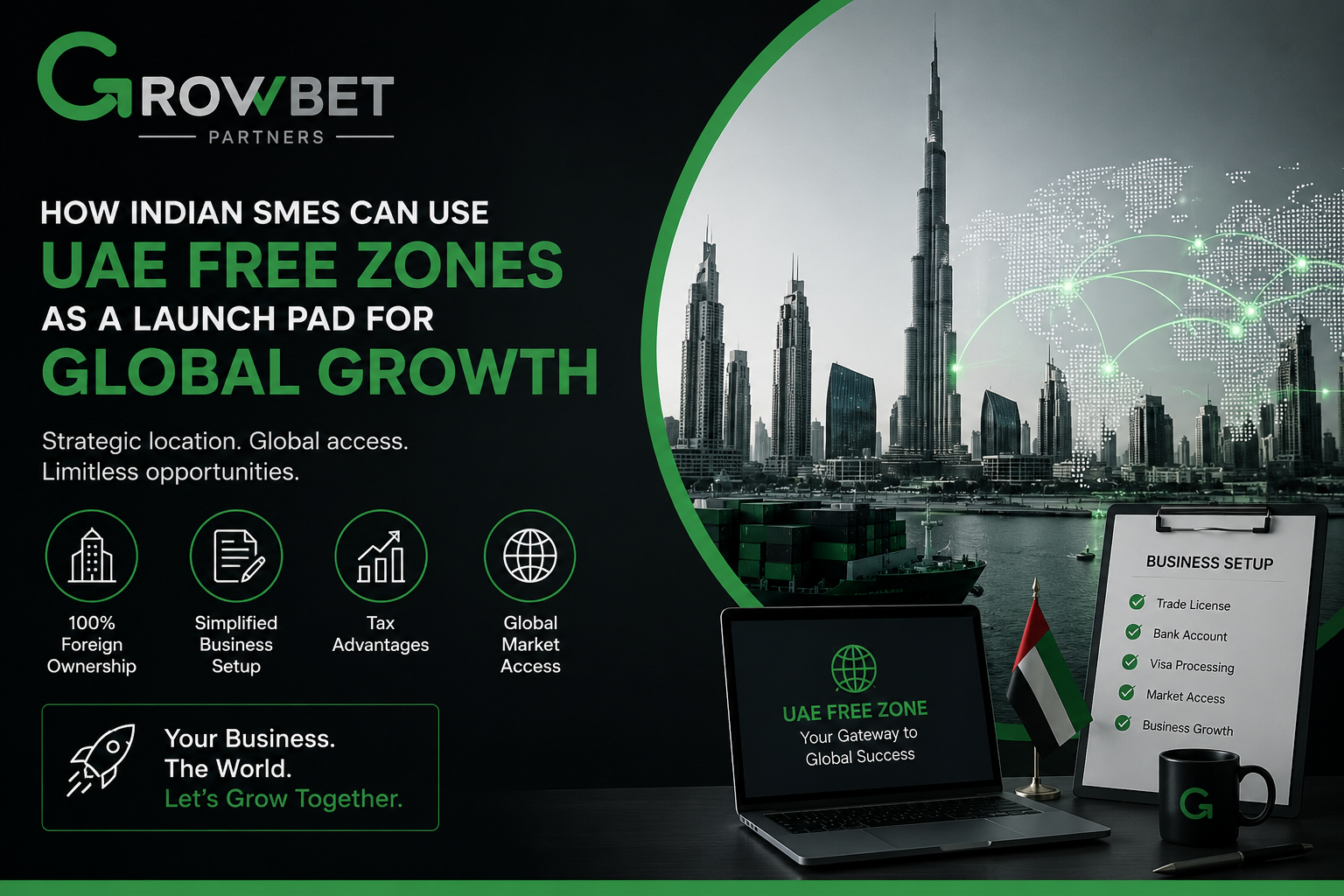
Setting up in a Dubai free zone isn’t just about entering the UAE market. For many Indian entrepreneurs, it’s the smartest first step toward going global.
When most Indian business owners think about expanding to the UAE, they think about Dubai. And when they think about Dubai, they eventually land on the same question: free zone or mainland?
It’s a reasonable starting point. But it misses the more interesting question, which is: what does a UAE free zone actually give you that you can’t get by just exporting from India?
The answer, for the right kind of business, turns out to be quite a lot.
What Free Zones Are (and Why They Were Built)
The UAE created free zones to attract international businesses by making setup simpler, ownership clearer, and operations more globally connected. Today there are more than 45 free zones across the UAE, each designed around specific industries such as technology, logistics, media, finance, healthcare, or manufacturing.
Unlike traditional mainland companies, free zone businesses generally allow:
- 100% foreign ownership
- Simplified company incorporation
- Tax advantages
- Streamlined customs processes
- Easier access to international banking and business services
For Indian SMEs, these aren’t just administrative conveniences. They are strategic advantages.
Why Indian SMEs Are Choosing UAE Free Zones
The first reason is credibility.
Having a UAE entity often creates greater confidence among international buyers, particularly across the Middle East, Africa, and parts of Europe. Many global customers are more comfortable signing contracts with a UAE-based company than working directly with an overseas exporter.
The second advantage is logistics.
Dubai sits within an eight-hour flight of nearly two-thirds of the world’s population. Through ports like Jebel Ali and major international airports, businesses can efficiently distribute products across GCC countries, Africa, Europe, and Asia.
Instead of shipping every order individually from India, companies can maintain inventory inside the UAE and fulfill regional demand much faster.
Third is access to global finance.
Many businesses find it easier to work with international payment providers, regional investors, multinational customers, and cross-border financial institutions once they have an established UAE presence.
Popular Free Zones for Indian Businesses
Different industries benefit from different ecosystems.
DMCC (Dubai Multi Commodities Centre) has become one of the world’s leading hubs for trading companies, precious metals, commodities, and professional services.
Dubai South has positioned itself around logistics, aviation, and e-commerce, particularly because of its proximity to Al Maktoum International Airport.
Dubai Internet City continues attracting technology firms, SaaS businesses, software companies, AI startups, and digital service providers.
IFZA (International Free Zone Authority) has become increasingly popular among SMEs because of its relatively affordable licensing options and flexible company structures.
Sharjah Media City (Shams) attracts creative businesses, consultants, marketing agencies, education providers, and digital entrepreneurs looking for lower setup costs.
The right choice depends far more on your operating model than on whichever free zone happens to be trending online.
Free Zones Are Not Magic
There’s a common misconception that simply registering a company in Dubai automatically generates business.
It doesn’t.
Free zones provide infrastructure—not customers.
You’ll still need market research, sales systems, partnerships, distribution, marketing, and relationship building.
Many Indian businesses mistakenly assume that obtaining a UAE trade license is the finish line when it’s actually the starting point.
Compliance also matters.
Each free zone has its own licensing rules, visa quotas, reporting requirements, renewal timelines, and permitted business activities. Choosing the wrong license can become expensive later if your business expands beyond its original scope.
Thinking Beyond the UAE
Perhaps the biggest advantage of a UAE free zone isn’t the UAE itself.
It’s everything beyond it.
Many successful Indian businesses use Dubai as their regional headquarters while serving customers across Saudi Arabia, Oman, Qatar, Kuwait, Bahrain, Egypt, Kenya, Nigeria, and even parts of Europe.
Instead of building separate entities in every country, they centralise operations in the UAE while expanding regionally.
For businesses planning long-term international growth, this creates operational simplicity that’s difficult to replicate elsewhere.
Final Thoughts
The UAE free zone ecosystem works best for businesses thinking beyond immediate sales.
If your ambition is simply to export one shipment, you probably don’t need a UAE company.
If your ambition is to build a regional brand, establish international credibility, attract global customers, and create scalable infrastructure for growth, then a UAE free zone becomes a strategic investment rather than an expense.
The businesses succeeding today aren’t just entering new markets.
They’re positioning themselves at the centre of global trade flows.
Keywords: UAE free zones for Indian SMEs | Dubai free zone business setup | Indian company UAE expansion | UAE global business hub