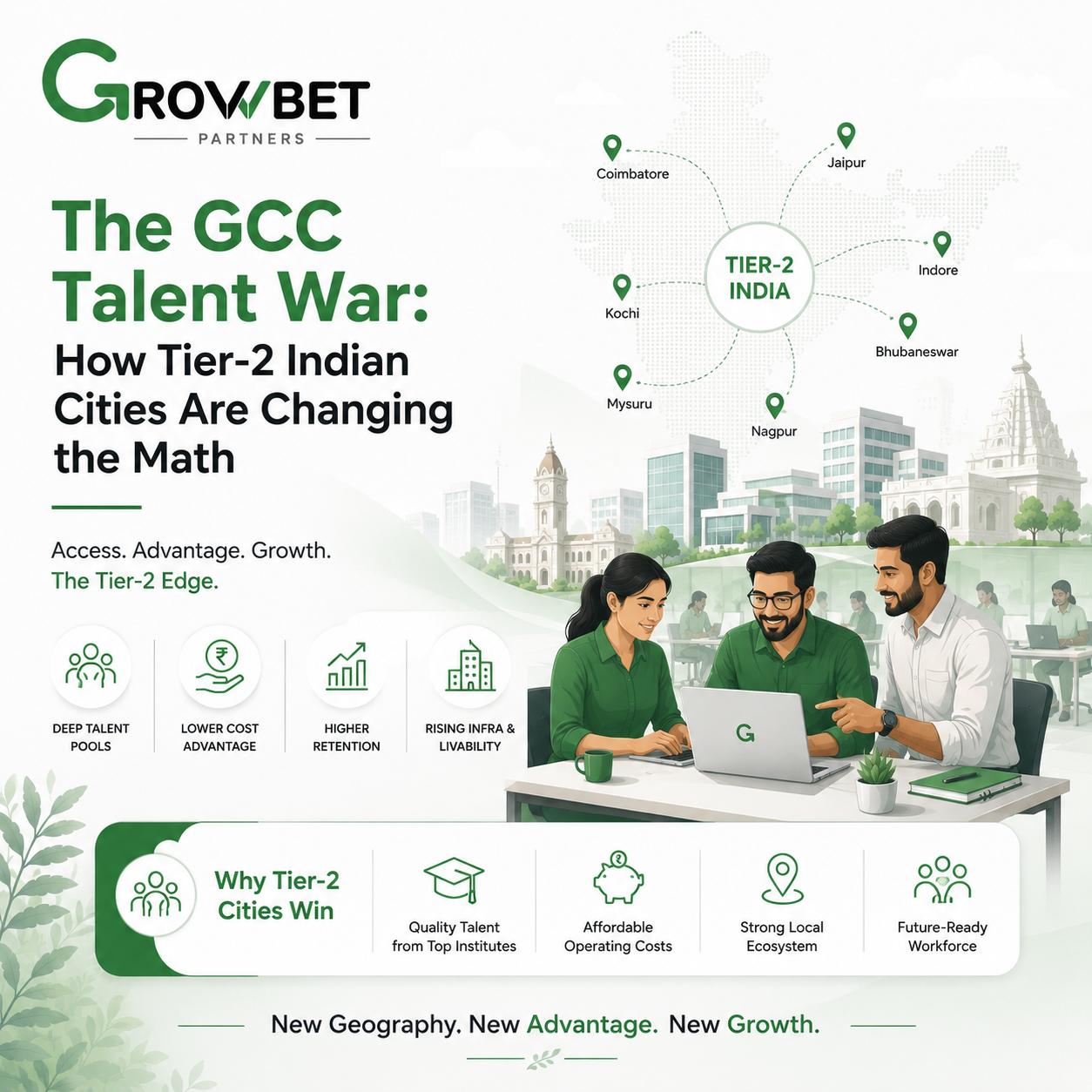
For over two decades, Global Capability Center strategy in India revolved almost entirely around Bengaluru, Hyderabad, Pune, Chennai, Mumbai, and the Delhi-NCR region. That map is changing. India’s roughly 1,900-plus GCCs now employ more than 2.1 million professionals, but emerging tier-2 cities already host over 220 GCC units and are growing at close to an 11% compound annual rate — faster than the traditional six-city cluster.
What Changed in the Traditional Hubs
Bengaluru remains the dominant hub, housing several hundred GCC units and around a third of the country’s GCC talent. But intense competition among GCCs, IT services firms, and startups for the same talent pool has pushed attrition and wage inflation higher in these mature markets, while commercial real estate costs in prime micro-markets have risen steadily, compressing the original cost advantage of an India-based center.
The Tier-2 Talent Pipeline Is No Longer Theoretical
Cities such as Coimbatore, Indore, Jaipur, Ahmedabad, Kochi, Vadodara, and GIFT City near Ahmedabad now produce meaningful volumes of engineering, finance, and analytics graduates each year. A cluster of five such cities — Ahmedabad, Coimbatore, Kolkata, Trivandrum, and Jaipur — already hosts more than 250 GCC units and close to 85,000 professionals between them. GIFT City in particular has attracted corporate treasury operations from large groups, helped by a 20-year tax holiday and regulatory changes that make it especially suited to finance-heavy GCC functions.
The Cost and Attrition Advantage
Attrition in these emerging cities typically runs 10 to 15 percentage points lower than in tier-1 metros, and some industry estimates put the combined talent-cost reduction at 30 to 40% once real estate and salary differentials are factored in. Lower attrition alone materially reduces the hidden costs of recruitment, onboarding, and lost productivity that quietly erode the apparent savings of a low-cost location. State-level policy is reinforcing the shift: Gujarat’s GCC Policy 2025-2030, for example, targets more than 250 new GCC units and over 50,000 jobs, backed by roughly ■10,000 crore in projected investment.
The Trade-offs GCCs Must Plan For
Tier-2 cities are not a universal substitute for established hubs. Industry surveys have flagged an AI talent gap approaching 40% as one of the biggest bottlenecks to GCC growth in smaller cities, with
the most complex AI and platform architecture roles often moving back to metro locations where specialized talent density is higher. A tier-2 city may be excellent for building stable capability around defined workflows and long-term process ownership, but it is not yet the right first base for scarce AI leadership or frontier research roles.
A Hub-and-Spoke Model Is Emerging
Many GCCs are adopting a hub-and-spoke structure: core leadership, specialized R&D;, and
client-facing functions remain in an established metro, while high-volume delivery functions such as finance operations, customer support, and standardized engineering work move to a tier-2 spoke location. This captures cost and attrition benefits without sacrificing access to scarce specialized talent.
What This Means for Site Selection in 2026
Companies evaluating new GCC locations should look beyond headline cost-per-employee figures and assess multi-year attrition trends, local university output by relevant discipline, existing GCC and IT services presence in the city, and state government incentives, several of which have expanded specifically to attract capability centers.
Conclusion
The GCC talent war is no longer confined to India’s four or five largest cities. Tier-2 locations have matured into credible, and in some cases superior, options for specific functions, even as specialized AI and frontier work continues to concentrate in established hubs. Companies that build a deliberate multi-city, hub-and-spoke strategy will have a structural advantage in both cost and talent retention over the next decade.